
The Visible Problem Is Not Always The Right Place To Start
When transformation begins to lose momentum, the pressure to act increases quickly.
All at once, it feels like decisions are taking too long, leaders are misaligned, teams seem hesitant, accountability is unclear. And because of all that, trust may be weakening.
When you’re in that situation, the natural response is to address whichever problem is most visible. But the visible problem is not always where the real constraint sits.
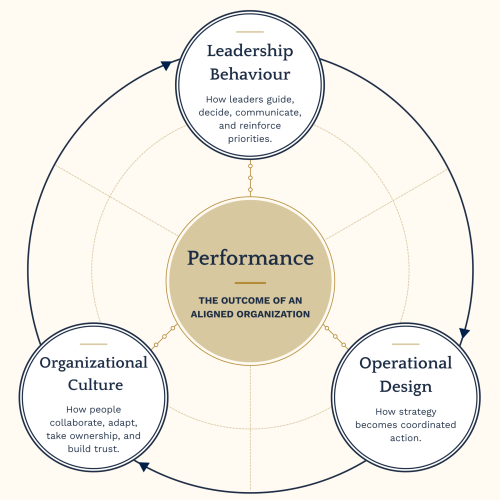
Leadership, Operations, and Culture are deeply interconnected. A weakness in one can create symptoms somewhere else, which means an organization can spend considerable time fixing what it sees without changing what is actually getting in the way.
The Same Problem Can Have Very Different Causes
Consider slow decision-making.
It may look like an execution problem, but the underlying cause could sit in several places.
- Leadership: Executives may not be fully aligned on the priority, the trade-offs, or the direction, leaving others reluctant to take action.
- Operations: Decision rights may be unclear, too many approvals may be required, or ownership may have become blurred.
- Culture: People may have learned that making the wrong decision carries more risk than waiting, escalating, or seeking further approval.
The symptom is the same, but the root cause and necessary solution may be quite different.
For example, adding another approval process will not solve executive misalignment. And conducting a leadership workshop will not fix unclear decision rights. Meanwhile, telling people to move faster will not help if the culture has taught them that taking initiative is unsafe.
Diagnose Before You Intervene
Choosing the wrong starting point has a real cost. It consumes attention, time, money, and organizational capacity, often when those resources are already under pressure.
That is why we created CraftXecs Transformation L.O.O.P.™, a diagnostic assessment that helps C-suite executives pinpoint what is constraining transformation so they can focus resources where they will have the greatest impact.
The assessment looks at Leadership, Operations, and Culture together, helping executives distinguish visible symptoms from the conditions creating them. It gives the CEO and executive team a stronger basis for action, along with a baseline against which progress can be measured.
Sometimes the priority is stronger alignment at the executive table. Sometimes it is clearer roles, decision rights, or accountability. Sometimes trust has deteriorated to the point that people hesitate to make decisions, raise concerns, or challenge direction.
When more than one condition needs attention, sequence matters. Leaders need to know what to address first, what can follow, and where limited resources will make the greatest difference.
Start With The Constraint, Not The Symptom
Transformation reshapes an organization and its leaders to meet a new ambition, challenge, or reality. That inevitably puts pressure on Leadership, Operations, and Culture at the same time.
The challenge for executives is understanding what is driving the problem well enough to act in the right place.
When the stakes are high, more activity is not the answer.
Better diagnosis leads to better decisions about where to focus, what to change, and how to move transformation forward.