
Why Strategy Stalls: The Three Conditions Successful Execution Depends On
By Karen Craft, CHRL, CEC
Earlier this month, I had the opportunity to speak at the Canadian Society of Association Executives (CSAE) Summer Summit about a challenge that almost every leadership team has experienced.
You invest months developing a thoughtful strategic plan. The priorities are clear. Everyone leaves the planning session energized.
Then, somewhere along the way, momentum fades.
Initiatives stall. New priorities emerge. Teams become stretched. The same strategic objectives appear on next year’s plan, still unfinished.
Execution Requires More Than Strategy
The problem is rarely the strategy itself.
Over the years, I’ve worked with leadership teams across organizations of different sizes and sectors. Along the way, we’ve used a variety of leadership, culture, organizational, and change assessments to understand why some organizations consistently execute while others struggle.
What became increasingly clear was that no single assessment ever told the whole story.
Leadership behaviour, operational design, and organizational culture all matter. But they don’t operate independently; they constantly influence one another.
The CraftXecs™ Transformation L.O.O.P.™
That realization led us to develop the CraftXecs™ Transformation L.O.O.P.™, a framework that brings together what we’ve learned from years of executive coaching, organizational assessments, strategic planning, operational design, change and transformation work. Rather than looking at one piece of the system in isolation, it helps leaders understand how leadership behaviours, operational design, and organizational culture work together to either strengthen or weaken execution.
At the CSAE session, participants completed a condensed version of the Transformation L.O.O.P.™ assessment and the discussion that followed surfaced several important patterns.
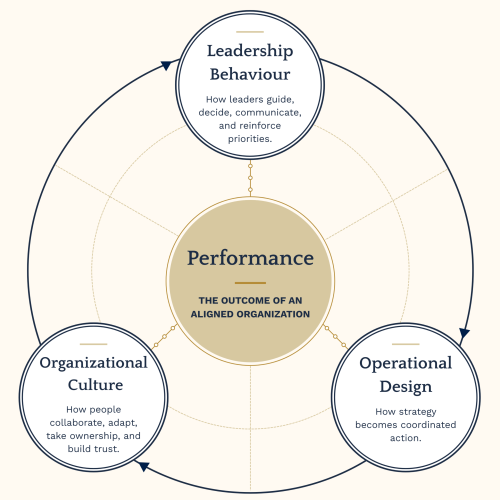
Leadership Behaviour
Leadership Behaviour scored well overall, but many participants described how difficult it has become to maintain alignment during periods of constant change. Leadership transitions, reorganizations, competing priorities, and limited capacity all made it harder to communicate consistently, both internally and externally. Several leaders spoke candidly about the tension between presenting confidence to boards, members, and stakeholders while their internal teams were quietly feeling the strain.
Operational Design
Operational Design emerged as the greatest opportunity.
Many organizations acknowledged they simply don’t have time to document processes, develop policies, or transfer critical knowledge. In smaller associations, one person often holds years of organizational knowledge that exists nowhere else. Everyone recognized the risk, yet documenting that knowledge rarely feels urgent.
Organizational Culture
Organizational Culture scored the strongest, but the discussion still surfaced an important challenge: as more organizations embrace hybrid and remote work, long-standing teams often remain deeply connected while newer employees struggle to develop the same relationships. Creating an inclusive culture now requires far more intentionality than it did when everyone worked together in the same office.
Simple, Yet Critical, Solutions
Perhaps the most encouraging part of the conversation was that the solutions weren’t complicated.
Leaders talked about developing realistic capacity plans instead of continually adding more work. They also identified the need for more transparent conversations with board leaders about operational realities, so priorities can be aligned with available resources.
Sharing knowledge was another priority. Several leaders acknowledged that holding onto work to protect their teams can unintentionally limit development opportunities. Transferring knowledge strengthens organizational resilience while creating opportunities for others to grow.
None of these ideas require rewriting a strategic plan.
They require strengthening the conditions that allow strategy to succeed.
That’s ultimately what the Transformation L.O.O.P.™ is designed to help leaders do.
Strategy sets the direction. Alignment across leadership, operations, and culture determines whether the organization can execute it.